

Technical · 6 min read
"Deburr all edges" is not a drawing instruction
One line in the title block leaves the shop to guess which edges are functional. Here is what to name instead, and why a chamfer is not the same thing as a deburred edge.
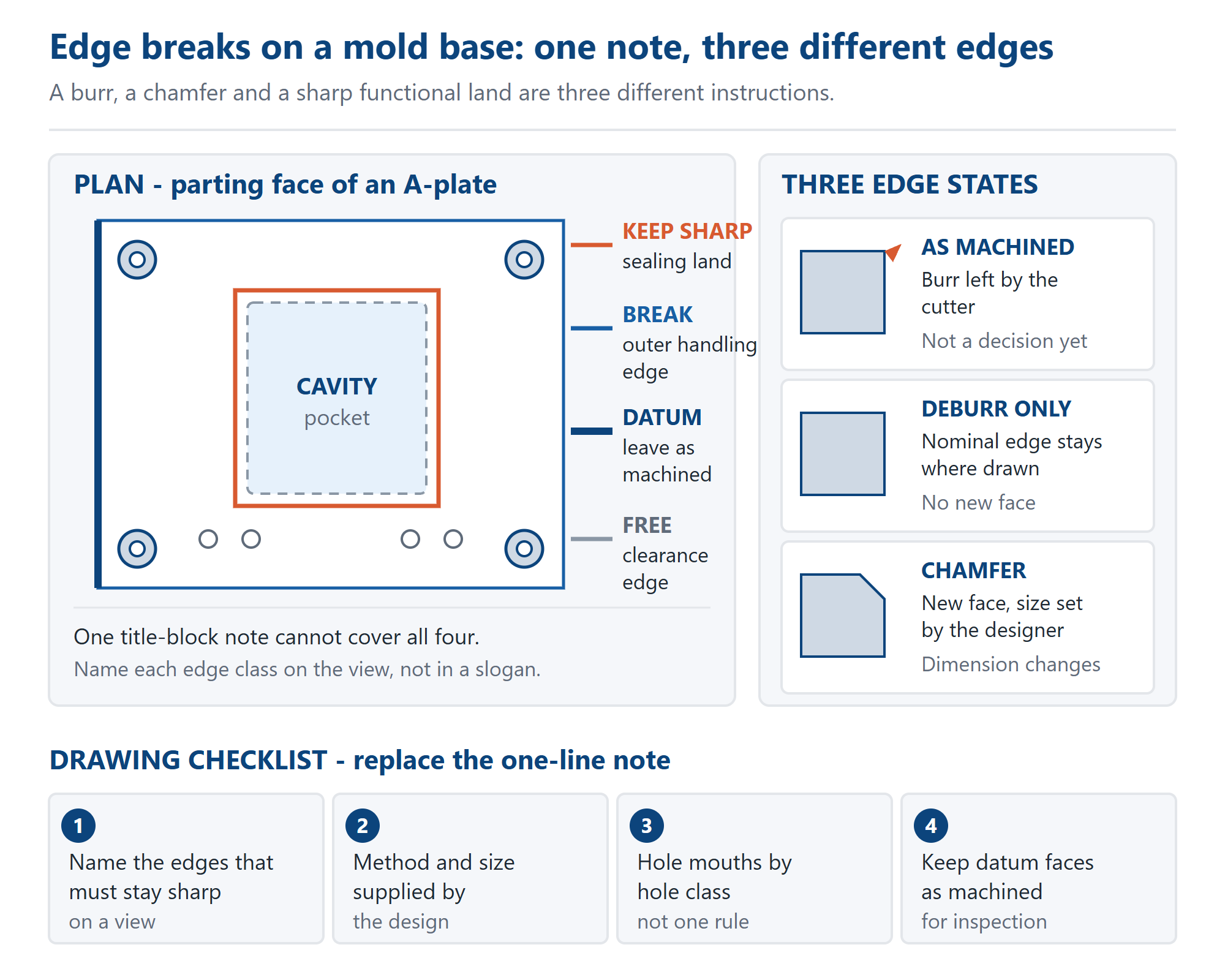
The last line of a title block is often an edge note: break all sharp edges, or deburr. On a mold base it is not, because one plate carries edges that must be broken, edges that must stay sharp, and edges where nobody has said which. The difference shows up late — at incoming inspection, when a sealing land will not hold, or when a fixture registers a few hundredths off. Settle it before cutting starts: it costs nothing on a drawing and a great deal on a finished plate.
Three kinds of edge, three different instructions. A functional edge does work: the sealing land around a cavity or water circuit, a shut-off face, a locating edge a fixture registers against, or a datum edge a dimension is measured from. A handling edge is one a person or tool touches — outer corners, lifting-hole mouths, the exposed edges of a plate stack. A free edge is everything else: a clearance side, a non-mating step, the outside of a spacer. One deburr line treats all three alike.
Why some edges have to stay sharp. A sealing land works by contact area, so rounding its outer edge narrows it; on a shallow land an uncalled break can remove the feature. Parting-line venting makes the same point: an uncontrolled stone can quietly close a shallow path. A chamfer also changes where a part sits against a stop. Datum edges are worse: a rounded edge has no single point to measure from. Two correct numbers from different datums will disagree at incoming inspection.
A burr is not a chamfer. Deburring removes the raised lip a cutter leaves, leaving the nominal edge where the drawing put it. An edge break deliberately removes material and creates a new face at a stated size and angle. A note that says deburr while the shop reads it as a chamfer has quietly changed the part. If you want a chamfer, call out the size and angle; if you only want the burr gone, say so and name the faces that must not be touched. We supply no universal edge-break value — the right one depends on the feature.
Hole mouths need their own line. A tapped hole wants a lead-in so the tap starts cleanly and the screw head seats flat; thread depth and the steel below it is a separate question, but the mouth belongs on the same view. A guide bore wants the opposite: a generous mouth chamfer shortens the guided length. Guide pillar bores are worth protecting. Water ports are a special case — the plug seat and any O-ring face are sealing surfaces, so a chamfer there belongs to the design, not to a finishing habit. Listing mouth treatment by hole class stops them being treated as one operation.
Uncontrolled stoning is a tolerance problem, not a cosmetic one. A flap wheel or hand stone can take a few hundredths off one area without changing the rest of the plate. On fitting and ground faces our own callout is ±0.02 mm with a ground finish of Ra 0.8 µm; on non-fit dimensions the general convention is 0.3 mm. Those are our shop specifications, not a claim of compliance with an external standard, and are measured on the machined face. If that face is polished afterwards, the inspection record describes a surface that is no longer there.
Never make a broken edge the datum. Where a drawing measures from a plate edge, that edge has to survive finishing. If the only straight edge is also the one being chamfered, the dimension has no fixed origin. Mark the datum faces and state that they stay as machined. The same logic applies to ground faces and the parting line: a face meant to seal should not reach a finishing operation with no instruction.
Where the burr goes matters too. A burr raised at the exit of a drilled water line or along a pocket mouth can break loose in service and end up between two faces meant to seal. — an assembly problem, not a cleanliness one. Specify that through-holes are deburred on both sides, and that swarf is cleared from blind pockets and drilled circuits before the plates are stacked. Deep-hole-drilled cooling channels are the awkward case: a long bore has an entrance and an exit, each worth a line.
What to put on the drawing. The useful version of the note is a short list, not a slogan. Name the edges to be broken and the method — burr removal only, a chamfer, or a radius. Give the size and angle from the design, not the shop. Call out the edges that must remain sharp on a view, not in prose. Separate hole-mouth treatment by hole class, say whether hand finishing is permitted on fitting faces, and name the datum faces left as machined. Six lines replace a note every reader interprets differently.
And what to put in the order. Attach that list to the plate list, because the plate list decides what gets cut. Say who owns the edge treatment when a bought-in component arrives with its own chamfer, and whether the mating plate is machined to suit it. Ask for the as-built record to name the faces measured. None of this adds a machining step; it removes a decision otherwise made on the floor. The written order confirmation can restate the six lines.
When you source a mold base from China, this is mostly a documentation problem. Buyers working with Chinese mold base suppliers cannot point at the edge they meant, and a photograph afterwards does not settle whether a functional land was rounded. The drawing has to carry the answer. Our shop in Dongguan, China works from the plate list and its callouts; supplying those with the enquiry is what makes the first set of plates match the second. Distance adds no extra party; it removes the informal conversation that would fill the gap. That is one practical part of what buying a mold base from China actually involves.
How to read the symptoms. A sealing land that will not hold, a stop that registers a fraction off, a guide bush loose in the first few millimetres, or an inspection number differing by a few hundredths — each can trace back to an edge altered after machining without a callout. Check the edge note first: the plate may be exactly to the dimension specified. Ask for as-built values on that face, not a pass or fail.
Send the drawing with the functional faces marked, the datum named and the edge note split by edge class. We confirm what we will hold before quoting. The same applies whether you order a standard plastic mold base, an injection mold base, a precision ground base or a custom non-standard base. Custom mold bases from our Dongguan mold base lines usually ship in 7–10 days; capacity is 2,000+ sets and pieces per month; and you deal directly with the factory that cut the plates — so the person answering an edge question stands at the machine.
Related